Auto Group Joiner: Advanced Strategies, Best Practices, and How to Avoid Facebook Bans
If you have read our introduction to Auto Group Joiner, you know the basics: the tool submits join requests to Facebook groups on your behalf so you do not have to click through each one manually. That article covers the fundamentals -- what the tool does, how public and private groups differ, and why building a group portfolio matters.
This article goes deeper. It covers the strategies that separate a productive group portfolio from a bloated one, the pacing and behavioral patterns that keep your account safe, and the specific mistakes that get accounts restricted or banned. If you are already using Auto Group Joiner and want to get more from it while taking less risk, this is where to focus.
The Strategic Layer Most People Skip#
Most users approach group joining with a simple formula: find groups in my niche, join as many as possible, start posting. This is understandable but incomplete. The groups you join determine the ceiling of your group marketing results, and most people fill their portfolio with groups that will never deliver meaningful returns.
Quality Scoring Before Joining#
Before you send a single join request, evaluate each group against these criteria:
Activity ratio. A group with 50,000 members but only three posts per week is effectively dead. Look for groups where daily post volume suggests genuine engagement. FaceBot's Group Search and Extract tool can surface activity metrics that help you filter before joining.
Admin responsiveness. Groups with active admins tend to have higher engagement and stricter moderation -- both good signs. Groups where the admin has not posted in six months are often abandoned, which means low engagement and high spam.
Member overlap. If you are already in five bodybuilding groups, the sixth one probably has 60-70% member overlap with the groups you are already in. Diminishing returns set in fast within a tight niche. Diversify across adjacent niches to maximize unique audience reach.
Post visibility. Some groups are configured so that every post requires admin approval, and the admin only approves posts twice a week. Others let approved members post freely. The approval bottleneck determines how quickly your content reaches the group.
Group rules compatibility. Read the group rules before joining. If the rules prohibit the type of content you plan to share, joining wastes a slot in your portfolio and risks getting you removed or reported when you post.
Portfolio Architecture#
Think of your group portfolio as a deliberate structure, not an ever-growing list.
Tier 1: Core groups (5-10). These are the highest-quality, most active groups in your primary niche. You will post here regularly and engage with other members' content. These groups drive the majority of your results.
Tier 2: Adjacent groups (10-20). Groups in related niches where your content is relevant but you are not the primary audience. A fitness supplement brand might have Tier 2 groups in cooking, outdoor sports, and general health. Post less frequently here but maintain a presence.
Tier 3: Research groups (10-20). Groups you monitor for trends, competitor activity, and content ideas but rarely post in. These inform your strategy without requiring active participation.
Tier 4: Seasonal or campaign-specific groups (variable). Groups you join for specific campaigns or product launches and may leave afterward. Auto Group Joiner is especially useful for this tier since the groups change frequently.
This architecture prevents the common problem of joining 200 groups and posting the same content to all of them -- a pattern Facebook's algorithms are specifically designed to detect and penalize.
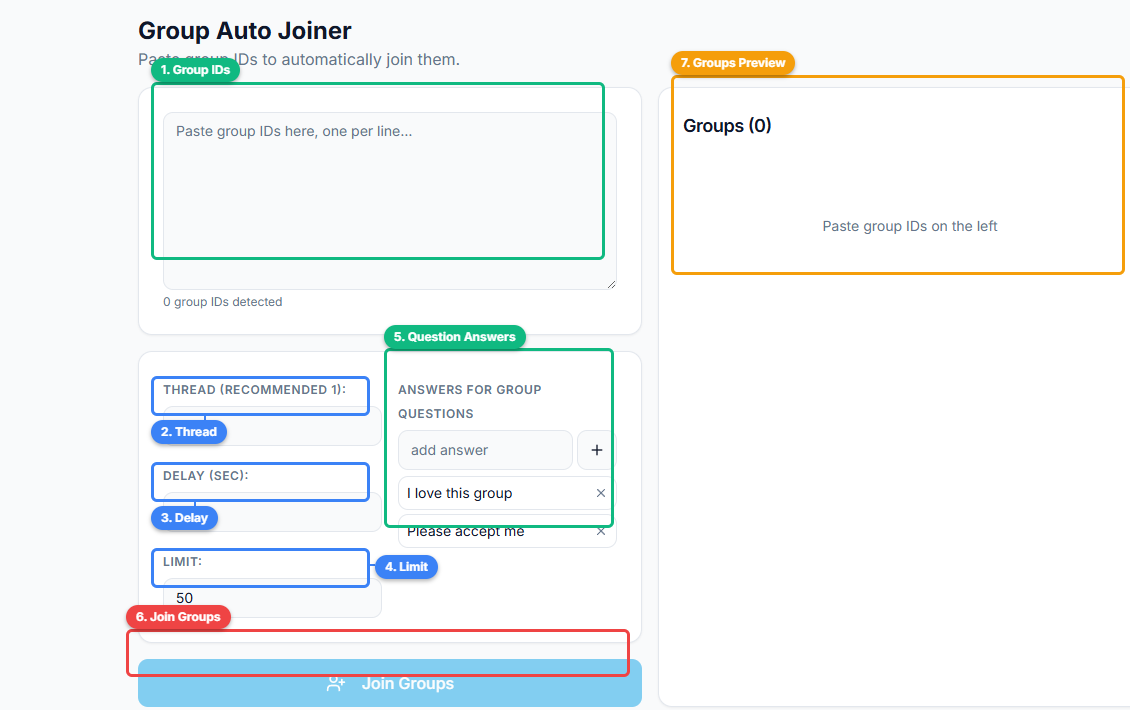
The Auto Group Joiner tool provides a streamlined interface. Paste group URLs one per line (1), configure delay between requests and concurrency threads (2), click Start to begin joining (3), and monitor results in the status panel (4).
Pacing: The Single Most Important Factor for Account Safety#
Facebook does not publish its exact rate limits for group-related actions, but the patterns are well established through collective experience. The most common reason accounts get restricted from joining groups is not what they do but how fast they do it.
The Numbers That Matter#
New accounts (under 30 days old). Do not use Auto Group Joiner on new accounts at all. Facebook scrutinizes new accounts heavily. Join groups manually, one or two per day, for the first month. Build a posting and engagement history before introducing any automation.
Established accounts (1-6 months). Keep join requests under 10 per day with at least 3-5 minute delays between each request. Mix automated joining with manual Facebook activity -- scrolling the feed, commenting on posts, reacting to content. The goal is that group join requests are a small percentage of your total account activity.
Mature accounts (6+ months with consistent activity). You can push to 15-20 join requests per day, but maintain delays and continue mixing with organic activity. Even mature accounts get flagged if group joining becomes a dominant behavior pattern.
Delay Configuration in Auto Group Joiner#
FaceBot's Auto Group Joiner lets you configure delays between requests. Use this. The temptation is to set the minimum delay and blast through your list, but this is the fastest path to a restriction.
Recommended delay settings:
- Minimum delay between requests: 180 seconds (3 minutes).
- Maximum delay between requests: 420 seconds (7 minutes). The randomized range between min and max prevents a detectable pattern of perfectly timed requests.
- Daily cap: Set a hard stop at your target number. Do not exceed it even if you have time left.
- Session breaks: If joining more than 10 groups, take a 30-60 minute break after every 8-10 requests.
Behavioral Signals That Trigger Restrictions#
Facebook's detection is not purely about speed. It looks at behavioral patterns:
- Joining without browsing. If your account sends join requests but never scrolls the feed, comments, or reacts, the automation signal is strong.
- Joining groups you have no connection to. If you live in Pakistan and suddenly join 20 local real estate groups in Kansas City, the geographic mismatch is a signal.
- Joining and immediately posting. Accounts that join a group and post within minutes are flagged more often than accounts that join and wait a day before posting.
- Consistent timing. Joining groups at exactly the same time every day suggests automation. Vary your schedule.
Handling Private Group Screening Questions#
Many high-value private groups use screening questions to filter applicants. These questions are a gate -- answering them poorly means your join request is rejected, and answering them well means you get into groups that most automated tools cannot access.
Common Screening Question Types#
Identity verification. "What is your name and what do you do?" Answer honestly. Admins often check your profile against your answer.
Relevance check. "Why do you want to join this group?" The correct answer demonstrates that you understand what the group is about and have a genuine reason to participate. Generic answers like "I want to learn" are weak. Specific answers like "I run a meal prep service and want to share recipes and get feedback from other fitness-focused cooks" are strong.
Rule acknowledgment. "Have you read and do you agree to the group rules?" Always answer yes, but actually read the rules first.
Anti-spam filter. "What is 2+2?" or "Type the word AGREE." These filter out bots that cannot parse natural language questions. Auto Group Joiner handles these differently depending on your configuration.
Strategy for Screening Questions#
For Tier 1 groups where acceptance matters, answer screening questions manually with thoughtful, specific responses. Use Auto Group Joiner for the join request submission but pause to fill in screening answers yourself.
For Tier 2-4 groups, you can configure standard answers in Auto Group Joiner, but generic answers have lower acceptance rates.
What to Do After Joining#
Joining groups is step one. What you do in the first 48 hours after joining determines whether the group becomes a productive asset or a wasted slot.
The First 48-Hour Protocol#
Hours 0-24: Observe only. Do not post anything. Read the recent posts. Understand the group's tone, what content gets engagement, and what the unwritten norms are. Every group has a culture beyond its posted rules.
Hours 24-48: Engage with existing content. Comment on two or three posts with genuine, helpful responses. React to posts. Answer questions if you can. This establishes you as a participant, not a broadcaster.
After 48 hours: Post your first content. Make it value-driven, not promotional. A useful tip, an interesting question, or a relevant resource. If your first post is promotional, many admins will remove it and flag your account.
This protocol applies per group. Yes, it means you cannot post in 50 new groups on the same day you join them. That constraint is a feature, not a bug -- it forces you to prioritize and ensures your early activity is genuine.
For ongoing content distribution across your groups, Group Auto Poster handles the posting workflow once you have established your presence.
Recovery: What to Do When Facebook Restricts You#
If you receive a restriction on group joining, here is the standard recovery approach:
- Stop all automated activity immediately. Do not try to "push through" a restriction.
- Wait out the restriction period. Facebook typically imposes 24-hour, 3-day, 7-day, or 30-day restrictions depending on severity and history. Do not try to circumvent the timer.
- During the restriction, use your account normally. Post on your own timeline, comment on friends' posts, engage with Pages. The goal is to re-establish a pattern of normal human behavior.
- When the restriction lifts, reduce your pace by 50%. If you were joining 15 groups per day before the restriction, start back at 7-8. Your account is now under closer scrutiny.
- Never appeal group-joining restrictions. Appeals draw human reviewer attention to your account, which often results in a deeper audit of your activity history. Restrictions expire on their own.
Integration with the FaceBot Group Marketing Stack#
Auto Group Joiner works best as part of a broader workflow. The complete guide to Facebook group marketing covers the full strategy, but here is how the tools chain together:
- Bulk Group Finder discovers candidate groups by keyword with metrics.
- Auto Group Joiner submits join requests with safe pacing.
- Group Auto Poster distributes content across your approved groups.
- Group Auto Commenter maintains engagement in group discussions.
- Group Viral Finder identifies high-performing content to model.
Each tool handles one piece of the workflow. Auto Group Joiner is the entry point -- everything downstream depends on having the right group memberships in place.
Limitations and Honest Expectations#
- Acceptance is not guaranteed. For private groups, admins decide whether to accept your request. No tool can force acceptance.
- Facebook's limits are real. There is no way to safely join 500 groups in a day. Safe scaling takes weeks, not hours.
- Group quality varies wildly. Joining 100 groups does not mean you now have 100 productive channels. Many groups are inactive, poorly moderated, or irrelevant despite appearing promising from the outside.
- Account age matters. New accounts face stricter limits. There is no shortcut around this.
- Screening questions require human judgment. Fully automated answers to screening questions have lower acceptance rates than thoughtful manual responses.
Frequently Asked Questions#
How many groups can I safely join per day?#
For established accounts (6+ months), 15-20 per day with proper delays is generally safe. For newer accounts, stay under 10. Always mix join activity with normal Facebook usage and watch for early warning signs like temporary blocks.
Will I get banned for using Auto Group Joiner?#
Bans for group joining alone are rare. Temporary restrictions on joining groups are more common and typically last 24 hours to 30 days. The primary risk factors are speed (too many requests too fast) and pattern (joining without any other account activity). Follow the pacing guidelines in this article to minimize risk.
Can Auto Group Joiner answer screening questions automatically?#
The tool can be configured with standard answers for common screening question formats. However, high-value private groups often have specific questions that require manual, thoughtful responses. For your most important target groups, answer screening questions yourself.
What happens if a group I joined removes me?#
Removal from a group is permanent unless you are re-invited or the admin reverses the removal. If you are removed from multiple groups for the same behavior (usually posting promotional content too aggressively), adjust your content strategy before joining more groups.
Should I leave groups that are not delivering results?#
Yes. A bloated portfolio of inactive or irrelevant groups clutters your Facebook experience and provides no value. Review your group memberships quarterly and leave groups where you have not engaged meaningfully in the past 30 days.
Conclusion#
Auto Group Joiner removes the mechanical friction of building a group portfolio, but the strategic decisions -- which groups to join, how fast to scale, and what to do after joining -- remain yours. The tool handles the clicking. You handle the thinking.
The difference between accounts that thrive with group marketing and accounts that get restricted comes down to pacing, targeting, and post-join behavior. Join the right groups at a sustainable pace, contribute before you promote, and treat every group as a community rather than a billboard.
Access Auto Group Joiner in your FaceBot dashboard.