
What Is Group Auto Commenter? Automate Facebook Group Engagement
Posting in Facebook groups gets your name in front of people. Commenting on other people's posts gets your name in front of them faster, more frequently, and with less friction. In most groups, a helpful comment on a popular post generates more profile clicks than a standalone promotional post ever will.
The problem is that meaningful group engagement takes time. Scrolling through posts, reading content, writing relevant comments, doing this across ten or twenty groups — it adds up quickly. Most marketers either burn hours on manual commenting or skip engagement entirely and wonder why their group marketing efforts fall flat.
Group Auto Commenter is a FaceBot tool that automates the commenting process. It lets you define comment templates, target specific groups, and execute commenting runs that would take hours to do by hand. This article explains what it does, how to use it well, and how to avoid the mistakes that turn automated commenting from a growth strategy into a liability.
How Group Auto Commenter Works#
The tool operates through a simple pipeline: you define what to say, where to say it, and how to space it out.
Step-by-Step Process#
- Select target groups. Choose one or more groups from your membership list where you want to engage.
- Define comment templates. Write one or more comment variations that the tool will use. Multiple templates prevent repetition.
- Configure targeting. Decide whether to comment on recent posts, posts with certain keywords, or the most popular posts in the group.
- Set pacing. Define delays between comments to keep the activity pattern natural.
- Run the commenting session. The tool navigates to each group, identifies eligible posts, and leaves comments based on your templates and settings.
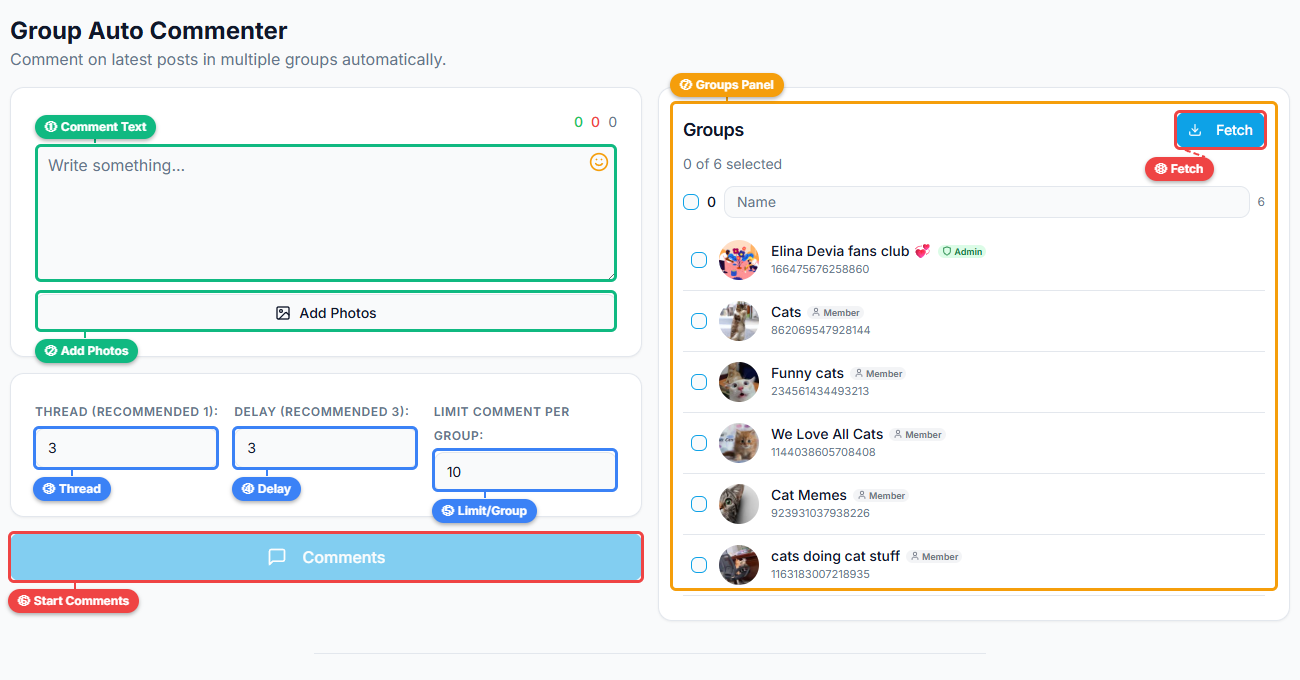
The screenshot above shows the Group Auto Commenter interface. On the left side you have the comment text area (1), photo attachment option (2), threading and delay controls (3, 4), a per-group comment limit (5), and the main action button (6). On the right, the groups panel (7) displays all your joined groups after clicking Fetch (8), letting you select which ones to target.
Everything happens through your own Facebook account. The tool does not create fake profiles or use anyone else's credentials — it is you, commenting as yourself, just faster.
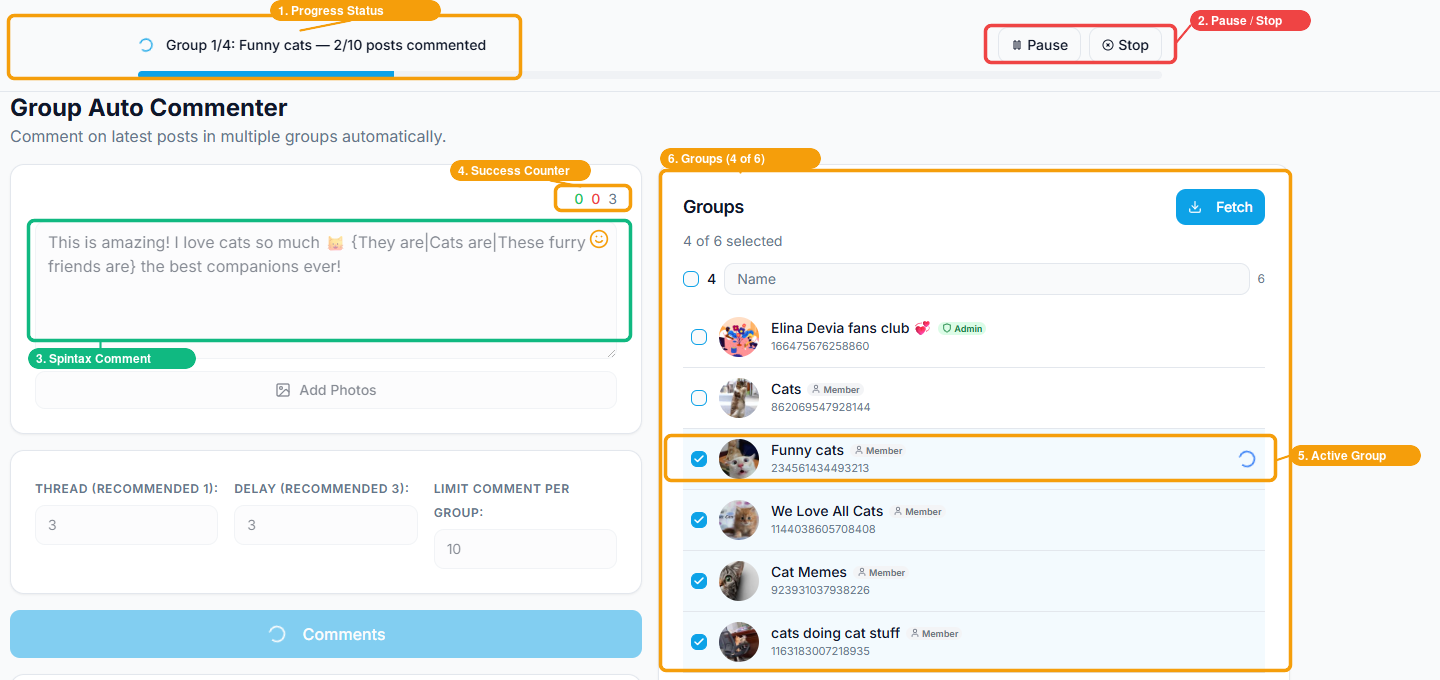
Here is the tool mid-run. The progress status (1) shows which group is being processed and how many posts have been commented. Pause and Stop controls (2) let you halt the session at any time. The comment area (3) shows your spintax template being used, the success counter (4) tracks completed comments, and the groups panel highlights the active group (5) currently being processed alongside all selected groups (6).
Template System#
The template system is where the difference between lazy automation and smart automation lives. A single generic comment like "Great post!" repeated across fifty posts will be flagged as spam by moderators within hours.
Effective templates are specific enough to look genuine but flexible enough to apply broadly. For example:
- "This is a really useful breakdown. The point about [topic keyword] is especially relevant right now."
- "Thanks for sharing this. I have been looking into [topic keyword] and this adds a lot of context."
- "Good insight here. Does anyone have experience implementing this at scale?"
The brackets indicate where you customize for the group's niche. A real estate group gets real estate language. A fitness group gets fitness language. The structure stays the same but the content feels tailored.
Why Commenting Matters More Than Posting#
Most group marketers focus exclusively on their own posts. This is backwards for several reasons.
Visibility Through Others' Audiences#
When you comment on a popular post, everyone who views that post sees your comment. If the post has 200 comments and yours is insightful, hundreds of people see your name, your profile picture, and your message. Creating a post that gets 200 views in a group is much harder than commenting on one that already has that traffic.
Algorithm Benefits#
Facebook's algorithm considers your engagement activity when deciding how to distribute your own posts. Accounts that actively engage in a group — through comments, reactions, and replies — get better organic reach when they do post their own content. The algorithm treats engaged members as more relevant to the group.
Authority Building#
Consistent, thoughtful comments build a reputation over time. Group members start recognizing your name. When you eventually post your own content, people are more likely to engage because they already know you contribute value. This is the opposite of the "post and disappear" pattern that most group marketers fall into.
Lower Spam Risk#
Groups that heavily moderate self-promotional posts are often much more lenient with comments. A comment that adds value to a discussion is welcome even if your profile links back to a business. A standalone promotional post might be deleted within minutes in the same group.
Who Should Use Group Auto Commenter#
Brand Builders#
If you are building a personal brand or business presence in specific niches, consistent commenting is one of the highest-return activities you can do. FaceBot's Group Auto Commenter makes it possible to maintain that consistency across many groups without dedicating hours to it daily.
Service Providers#
Consultants, freelancers, and agencies who find clients through Facebook groups benefit enormously from visibility. Commenting on posts where people ask for advice in your area of expertise positions you as someone who knows the subject — without being overtly promotional.
Affiliate Marketers#
Affiliates need visibility in groups where their target audience hangs out. Commenting builds that visibility passively. Once people recognize your name from helpful comments, they are more likely to click on your profile and eventually your links.
Community Managers#
If you manage a brand that participates in multiple groups, keeping engagement consistent across all of them is a staffing challenge. Auto-commenting reduces that burden while maintaining presence.
Best Practices for Auto-Commenting#
Write Quality Templates#
This is the single most important factor. Templates that read like generic filler will get you flagged as spam. Templates that demonstrate genuine engagement will build your reputation. Invest time in writing ten to fifteen high-quality, niche-specific comment templates.
Use Multiple Variations#
Never run a commenting session with a single template. Even a well-written comment becomes suspicious when moderators notice the same text appearing on multiple posts. Rotate through at least five to ten variations per session.
Pace Your Comments#
Leaving fifteen comments in a group within two minutes is not how real people behave. Set delays of at least thirty seconds to one minute between comments, and limit the total number of comments per group per session. Five to ten comments per group per day is a reasonable ceiling for most groups.
Target Relevant Posts#
Commenting on every post in a group regardless of topic looks automated. Configure the tool to target posts related to your niche or posts that have already gained traction. A comment on a popular, relevant post does more for your visibility than ten comments on posts nobody reads.
Supplement with Manual Engagement#
Auto-commenting handles the volume. You should still manually respond to replies on your comments, engage in threads that develop into real discussions, and occasionally leave genuinely personal comments that no template could generate. The combination of automated volume and manual depth is the winning pattern.
Auto-Commenting vs. Manual Commenting#
| Aspect | Manual Commenting | Group Auto Commenter |
|---|---|---|
| Time for 10 groups, 5 comments each | 60-90 minutes | 5-10 minutes |
| Consistency across groups | Inconsistent — easy to skip groups | Uniform coverage |
| Comment quality | High if you focus, drops with fatigue | Consistent per template quality |
| Scale ceiling | 3-5 groups realistically | 20+ groups comfortably |
| Reply management | Built-in (you are already there) | Requires separate manual follow-up |
The hybrid approach works best: automate the initial commenting for volume and visibility, then manually follow up on replies and discussions that develop.
🚀 Ready to try Group Auto Commenter?
Drop comments on group posts automatically
Open it Now →Risks and How to Mitigate Them#
Spam Detection#
Facebook monitors for repetitive commenting behavior. Mitigation: use diverse templates, pace comments, and avoid sessions longer than twenty to thirty minutes.
Moderator Action#
Active group admins will notice and remove low-quality comments. Mitigation: write templates that genuinely add value. If your comment would pass a moderator's manual review, it will survive in the group.
Irrelevant Comments#
Auto-commenting on posts outside your niche makes you look like a bot. Mitigation: use keyword targeting to filter for relevant posts, and exclude post types that do not benefit from your standard templates.
Account Restrictions#
Excessive commenting across many groups in a short window can trigger temporary Facebook restrictions. Mitigation: keep daily comment volumes within human-plausible ranges. Twenty to thirty total comments across all groups per session is a conservative, safe number.
How It Fits Into Your Group Marketing Stack#
Group Auto Commenter is most effective when paired with other group marketing tools:
- Use Group Auto Poster to distribute your own content across groups.
- Use Group Auto Commenter to build visibility between your posts.
- Use Group Viral Finder to identify the most popular posts worth commenting on.
- Use Spam Post Remover to keep your own groups clean while growing through others.
The posting gets your content out. The commenting gets you noticed. Together, they create a compounding effect where your name becomes familiar across your target communities.
Try Group Auto Commenter#
If you are investing time in Facebook group marketing but only posting, you are leaving the highest-leverage activity on the table. Commenting builds visibility, authority, and algorithmic favor — and Group Auto Commenter makes it sustainable at scale. For a broader strategy on using groups for business growth, see the complete guide to Facebook group marketing.
Open Group Auto Commenter in FaceBot
Frequently Asked Questions#
Is auto-commenting against Facebook's terms of service?#
Facebook's terms prohibit spam and inauthentic behavior, not the use of tools. The key factor is the quality and authenticity of your comments. Generic spam comments violate the spirit of the rules. Well-crafted, relevant comments that contribute to discussions do not, regardless of how they were delivered.
How many comments can I leave per day without getting restricted?#
There is no published limit from Facebook. Based on user experience, twenty to forty comments per day spread across multiple groups with reasonable pacing is generally safe. Exceeding a hundred comments per day or commenting more than ten times in a single group within an hour increases the risk of temporary restrictions.
Can I target specific types of posts to comment on?#
Yes. You can filter by keywords, post recency, and post engagement levels. This lets you focus your comments on posts that are relevant to your niche and already have audience attention, maximizing the visibility return per comment.
Will people know I am using an auto-commenting tool?#
Not if your templates are well-written and varied. The comments appear as normal comments from your account. The only way someone would suspect automation is if they see identical or near-identical comments from you across multiple posts — which is why using multiple diverse templates is essential.
Does this work for group posts or also for page posts and personal posts?#
Group Auto Commenter is designed specifically for Facebook group posts. For engagement with page posts or personal timeline posts, FaceBot offers separate tools tailored to those contexts.
Conclusion#
Commenting is the underrated half of Facebook group marketing. Most people focus on posting their own content and ignore the engagement layer that actually builds visibility, reputation, and algorithmic advantage. Group Auto Commenter makes consistent, high-volume commenting viable without the time investment that makes it impractical by hand. Combined with quality templates and smart pacing, it turns passive group membership into active brand presence.